Aluminium door installation directly affects how smoothly a door operates, how well it seals against weather and noise, and how long the system lasts. The most common failures come from inaccurate measurements, poor alignment, incorrect fixing, inadequate sealing and unsuitable hardware. A precision-led installation can prevent these problems and protect the door’s performance and appearance.
Table of Contents
ToggleWhat Is Aluminium Door Installation?
Aluminium door installation is the process of accurately positioning, fixing, aligning, sealing and finishing an aluminium door system within its opening. It includes more than simply attaching the door to a frame.
A professional installation should account for:
- Opening dimensions
- Frame alignment and level
- Door weight and configuration
- Hardware positioning
- Clearances
- Sealing and weather protection
- Glass or panel installation
- Final operation and adjustment
For luxury homes, commercial buildings, hotels and premium developments, installation quality is particularly important because even a premium door can perform poorly if it is fitted incorrectly.
Hav’dor’s aluminium range is engineered for modern Indian spaces and includes entrance, sliding and interior applications, with weather and moisture resistance, tight sealing systems and precision installation support.
Why Is Correct Aluminium Door Installation Important?
A properly installed aluminium door can provide:
- Smooth opening and closing
- Better resistance to moisture and weather
- Improved acoustic performance
- Longer hardware life
- More consistent sealing
- Better security
- Cleaner architectural appearance
- Reduced maintenance
- Better long-term structural performance
For architects and builders, correct installation also reduces site corrections, complaints and replacement costs.
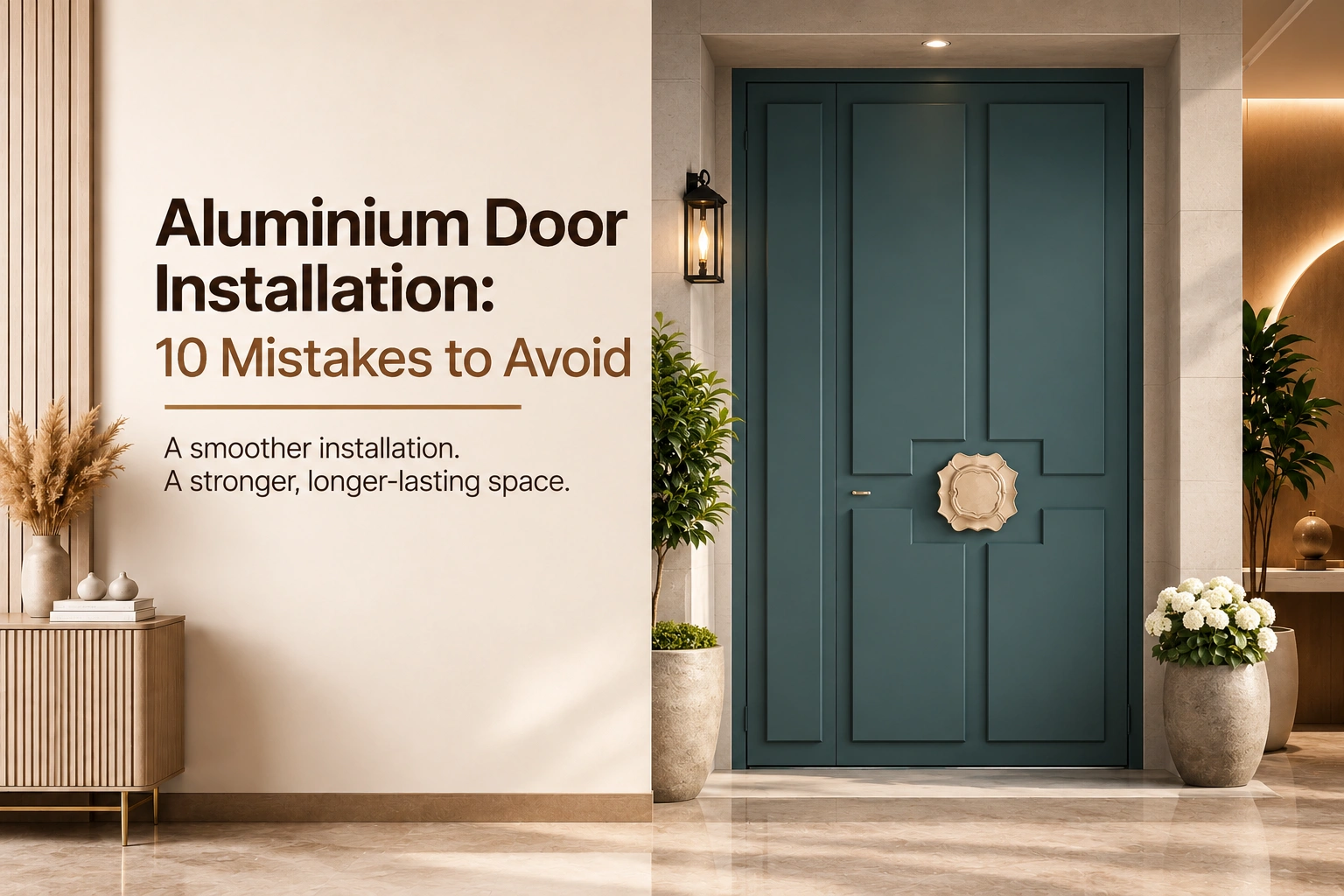
10 Aluminium Door Installation Mistakes to Avoid
1. Taking Incorrect Measurements
One of the most expensive mistakes is measuring the opening incorrectly.
The width, height, diagonals and depth of the opening should be checked before fabrication or installation. Walls may not always be perfectly square, particularly in renovation projects.
Solution: Measure at multiple points and verify the finished opening before fixing the frame.
A detailed aluminium door installation guide should always begin with site measurement rather than assuming the opening is perfectly uniform.
2. Installing on an Uneven or Unprepared Opening
The frame should not be expected to correct major problems with the surrounding wall.
Uneven surfaces can cause:
- Frame distortion
- Unequal gaps
- Difficult door movement
- Seal failure
- Premature hardware wear
Before installation, the opening should be structurally sound, clean and appropriately prepared.
This is especially important for premium renovation projects where an existing opening may have been altered several times.
3. Failing to Check Frame Alignment
A frame can appear visually acceptable while still being slightly out of plumb or level.
Small alignment errors can become obvious when the door is opened and closed repeatedly.
Check:
- Plumb
- Level
- Diagonal measurements
- Frame squareness
- Consistent clearances
A properly aligned frame allows the door leaf and hardware to work as intended.
4. Using Incorrect Fixing Methods
The frame must be secured using an appropriate fixing strategy for the substrate and door system.
Weak or poorly positioned fixings can allow movement over time. This may lead to gaps, misalignment and operational problems.
The fixing method should be determined according to the wall construction, frame specification and manufacturer’s recommendations.
Professional aluminium door fitting should therefore be treated as an engineered installation process rather than a generic carpentry task.
5. Ignoring Drainage and Water Management
For exterior, balcony, patio and entrance applications, water management is critical.
Poor installation can allow rainwater to collect around the frame or migrate into the interior.
Depending on the system, installers should consider:
- Drainage paths
- Sill positioning
- External exposure
- Sealant application
- Threshold detailing
- Water run-off
Hav’dor’s aluminium doors are positioned for Indian conditions, with weather and moisture resistance as key product characteristics.
6. Applying Sealant Incorrectly
Sealant is not simply a finishing material. It can play an important role in protecting the opening against air and water infiltration.
An incomplete or inconsistent bead can create weak points. Excessive sealant can also create an untidy finish and interfere with drainage.
Good aluminium door sealing requires the correct product, surface preparation and application method.
The seal should be continuous where specified, while drainage paths must remain functional.
7. Installing Hardware Without Proper Adjustment
Handles, hinges, locks, rollers and closers need to work with the door’s weight and configuration.
Incorrect hardware selection or adjustment may result in:
- Stiff operation
- Door sagging
- Uneven closing
- Excessive friction
- Locking problems
- Premature component failure
For premium projects, aluminium door hardware should be selected as part of the overall door specification rather than as an afterthought.
8. Installing Sliding Doors Without Checking the Track
Sliding systems require particular attention to track alignment.
Even a small installation error can make a sliding door feel heavy or uneven.
For sliding applications, check:
- Track level
- Roller alignment
- Frame squareness
- Door weight distribution
- Lock engagement
- Clearances
A precise sliding aluminium door installation process can significantly improve everyday usability.
Hav’dor’s aluminium portfolio includes sliding systems designed as space-saving solutions for patios and other modern spaces.
Also Read: Benefits of Aluminium Doors for Home
9. Skipping the Final Adjustment
Installation does not end when the screws are tightened.
The completed door should be tested several times.
Check whether:
- The door opens smoothly
- The door closes completely
- Locks engage correctly
- Gaps are consistent
- Seals make appropriate contact
- Handles operate comfortably
- Sliding panels move without excessive resistance
This final inspection is where small problems can be identified before the space is handed over to the homeowner or client.
10. Choosing Installation Based Only on Price
The lowest installation quotation is not necessarily the lowest overall cost.
A poorly installed premium door may require:
- Re-alignment
- Hardware replacement
- Sealant repairs
- Water-infiltration correction
- Reinstallation
- Premature replacement
For luxury residences and commercial projects, it is better to evaluate the complete installation solution, including measurement, manufacturing accuracy, installation expertise and after-sales support.
Aluminium Door Installation: Professional vs DIY
| Factor | Professional Installation | DIY / Untrained Installation |
|---|---|---|
| Measurement | Multiple-point verification | Often basic measurement |
| Frame alignment | Precision checked | Higher risk of error |
| Hardware | Professionally adjusted | May be incorrectly fitted |
| Sealing | System-specific | May be inconsistent |
| Sliding operation | Track and rollers calibrated | Alignment problems possible |
| Final inspection | Included | Often overlooked |
| Long-term performance | More predictable | Higher maintenance risk |
For high-value aluminium doors, professional installation is generally the safer approach.
Step-by-Step: How Professional Aluminium Door Installation Should Work
Step 1: Inspect the opening
Confirm dimensions, substrate condition and structural readiness.
Step 2: Verify the door specification
Check frame type, configuration, hardware, glass or panel requirements and finish.
Step 3: Position the frame
Set the frame accurately within the opening.
Step 4: Check alignment
Verify level, plumb, diagonals and clearances before permanent fixing.
Step 5: Secure the frame
Use appropriate fixing points and methods for the substrate.
Step 6: Install the door
Fit the panels or leaf and install the specified hardware.
Step 7: Complete sealing
Apply appropriate sealing while maintaining required drainage paths.
Step 8: Adjust and test
Check movement, locking, gaps, seals and overall operation.
Step 9: Clean and inspect
Remove installation residue and inspect the finished appearance.
Step 10: Handover
Explain operation, maintenance and basic care to the homeowner or project team.
When Should You Choose Aluminium Instead of Wood?
Aluminium can be particularly useful where the project demands weather resistance, moisture resistance, sleek profiles and relatively low maintenance.
For example, bathrooms, balconies, patios, offices and contemporary entrances can benefit from aluminium systems.
For traditional or warmer architectural aesthetics, however, engineered wood may be more appropriate. Hav’dor’s range also includes solutions from wooden to aluminium doors, allowing designers to select different materials within one broader portfolio.
For projects requiring a premium timber aesthetic, you can also explore Hav’dor’s range from specialist wooden door manufacturers.
Hav’dor’s Approach to Aluminium Door Installation
Hav’dor treats installation as part of the overall door solution rather than a separate final-stage activity.
Its aluminium door range highlights precision installation using European tools and a stated 120-minute installation process, alongside weather and moisture resistance, tight sealing systems and premium powder-coated finishes.
This integrated approach can be particularly valuable for architects, builders and developers managing multiple openings across a project.
Hav’dor also offers different entrance configurations, including aluminium entrance doors, aluminium-wood combinations and glass-aluminium designs.
Hav’dor’s Readymade Door Portfolio in India
Hav’dor positions itself as a luxury readymade door brand in India with a broad portfolio spanning wooden, Alwood, aluminium and fire-rated doors. Its official website describes a one-stop range for residential and commercial applications, from bathroom doors and main entrances to hotel and specialized project requirements.
This breadth gives homeowners, architects and developers the option to coordinate multiple door requirements through one manufacturer instead of sourcing every category independently.
For example, a luxury villa could combine aluminium doors for selected exterior or moisture-prone areas with a premium main door specification for its statement entrance.
Similarly, projects requiring specialized safety solutions can coordinate their requirements with experienced fire doors suppliers.
For bathrooms, Hav’dor also provides aluminium options suitable for moisture-prone environments, making a washroom aluminium door a practical consideration where design and durability both matter.
Expert Recommendation
The biggest aluminium door installation mistake is treating installation as a simple fitting exercise.
Measure accurately, prepare the opening, align the frame, use compatible hardware, seal correctly and perform a complete final inspection.
For luxury homes and professional projects, the best results come when design, manufacturing and installation are planned together.
Hav’dor’s focus on engineered aluminium systems, precision installation and multiple door categories makes it a practical option for homeowners, architects, interior designers, hospitality projects and developers looking for an integrated door solution.
Key Takeaways
- Accurate measurement is the foundation of successful installation.
- Never install over an improperly prepared opening.
- Frame alignment affects long-term door performance.
- Use appropriate fixing and hardware systems.
- Do not compromise on weather sealing.
- Sliding doors require precise track and roller alignment.
- Always perform final adjustment and testing.
- Professional installation can prevent expensive corrections later.
- Choose a manufacturer that supports both the product and installation process.
Frequently Asked Questions
1. What is the most common aluminium door installation mistake?
Incorrect measurement and frame alignment are among the most common problems. Even small inaccuracies can affect door movement, sealing and hardware performance.
2. Can aluminium doors be installed on any wall?
They can be installed on various wall types, but the fixing method must be appropriate for the substrate and the specific door system.
3. Why is sealing important during aluminium door installation?
Correct sealing helps reduce water and air infiltration and supports the weather-resistant performance expected from the door system.
4. How long does aluminium door installation take?
Installation time depends on the configuration, opening condition and project requirements. Hav’dor states that its precision installation process can be completed in approximately 120 minutes for applicable door systems.
5. Are aluminium doors suitable for Indian weather?
Yes. Properly designed aluminium systems can offer strong weather and moisture resistance. Hav’dor specifically positions its aluminium doors for Indian climatic conditions.
6. Should I choose aluminium or wooden doors?
The choice depends on location, climate exposure, design intent, maintenance expectations and performance requirements. Aluminium is particularly useful for moisture and weather-exposed applications, while engineered wood can provide a warmer architectural appearance.
7. Can aluminium doors be customized?
Yes. Hav’dor offers customization across finishes, colours and configurations for its aluminium range.
8. Where can I see Hav’dor aluminium door designs?
You can explore the aluminium collection online or connect with Hav’dor’s team for design and installation guidance.
Get Expert Help With Your Aluminium Door Installation
Planning a luxury home, villa, hotel, office, commercial development or renovation project?
Call Us: +91 7027029188
WhatsApp Us: +91 7027029188
Email Us: contact@havdor.com