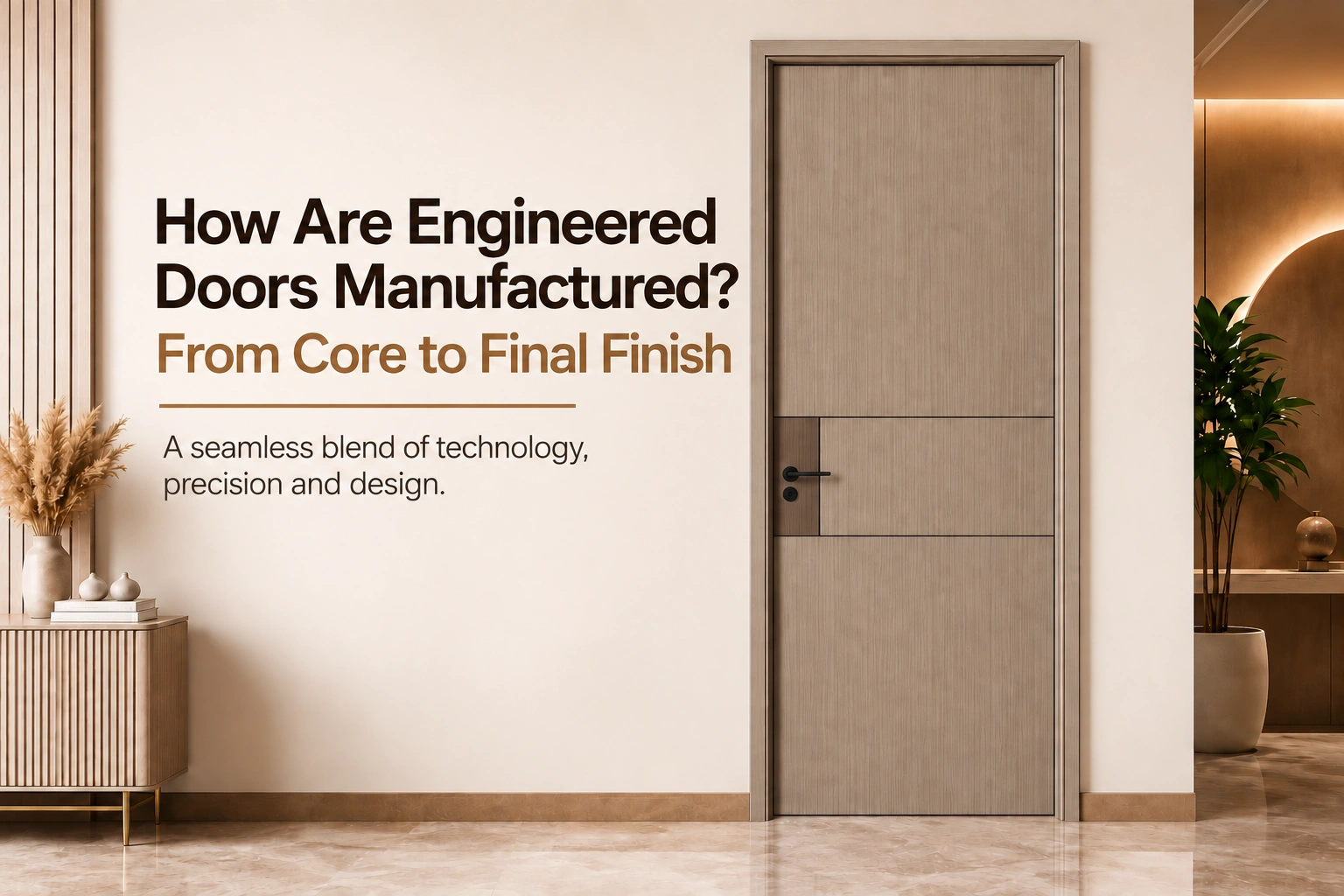
Engineered doors are manufactured by combining carefully selected materials, a stable internal core, precision bonding, premium surface finishes, accurate machining and strict quality checks. Unlike a single-piece solid timber door, the engineered construction is designed to improve dimensional stability, durability and consistency while giving architects and homeowners greater freedom in design and finish.
Table of Contents
ToggleWhat Is an Engineered Door?
An engineered door is a door constructed from multiple carefully selected layers or materials rather than relying entirely on one piece of solid wood. The core, bonding materials, surface layer, edges and hardware are designed to work together as one engineered system.
The manufacturing objective is not simply to make a door look premium. It is to create a product with predictable performance, dimensional stability and a consistent finish.
This is particularly relevant in India, where doors may be exposed to significant variations in temperature, humidity and everyday use. Hav’dor’s approach combines Indian craftsmanship with German engineering expertise and focuses on stability, moisture resistance, heat stability, termite protection, UV resistance and soundproofing.
Why Does Engineered Door Manufacturing Matter?
The manufacturing process directly influences how a door performs after installation.
A properly engineered construction can offer:
- Better dimensional stability than poorly constructed timber doors
- Greater resistance to warping and bending
- More consistent dimensions across multiple doors
- Better surface-finish consistency
- Improved sound insulation
- Greater design flexibility
- More predictable performance in changing climates
- Reduced maintenance requirements
For builders and developers, manufacturing consistency is particularly important because dozens or hundreds of doors may need to match in dimensions, finish and performance.
For homeowners, the benefit is simpler: the door should continue to look and operate as intended after years of everyday use.
How Are Engineered Doors Manufactured?
1. Material Selection Comes First
The manufacturing process begins with selecting appropriate raw materials.
For an engineered wooden door, this may include timber, engineered boards, core materials, veneers, decorative surfaces, adhesives and hardware.
The material must be suitable for the intended application. A bedroom door, luxury entrance, hotel door and moisture-prone bathroom opening may have different performance requirements.
Hav’dor’s wooden doors, for example, use Canadian Hem-Fir, German and Italian CPL veneers and PUR adhesive as part of their construction.
This stage is important because manufacturing cannot compensate for unsuitable raw materials.
2. Core Engineering Creates the Door’s Structure
The core is one of the most important parts of an engineered door.
Rather than relying on a single large piece of timber, engineered construction can use carefully designed internal layers or core materials to provide strength and stability.
The core influences:
- Structural stability
- Door weight
- Sound insulation
- Hardware performance
- Resistance to dimensional movement
- Overall durability
This is one reason buyers should look beyond the decorative surface when comparing engineered doors.
A premium-looking veneer does not automatically indicate a high-performance door. The internal construction matters just as much as what the customer sees.
3. Layers Are Bonded With Suitable Adhesives
After the core and structural materials are prepared, the different components are bonded together.
Adhesive selection and application are critical because the bond must remain reliable throughout the door’s service life.
Poor bonding can contribute to:
- Delamination
- Surface separation
- Edge problems
- Finish deterioration
- Reduced structural integrity
Hav’dor specifically identifies PUR adhesive as part of its engineered wooden door construction.
The objective is to create a stable composite structure rather than simply joining decorative layers together.
4. Pressing Creates a Stable Assembly
Once the layers are assembled, controlled pressing helps create a uniform bond across the door.
The pressure, alignment and manufacturing conditions need to be controlled consistently.
This stage helps ensure that:
- Layers remain properly positioned
- Surfaces remain even
- Bonding is consistent
- The finished door maintains its intended dimensions
For larger projects, manufacturing consistency at this stage becomes particularly important because every door must meet the same dimensional and quality requirements.
5. Veneer, CPL or Decorative Finish Is Applied
The next stage transforms the engineered structure into the finished architectural product.
Depending on the specification, the surface may receive:
- Natural veneer
- CPL
- Decorative laminate
- Painted finish
- Other architectural surface treatments
The finish determines much of the door’s visible character.
Hav’dor’s portfolio includes German and Italian CPL finishes, with its wooden doors designed around premium finishes that are resistant to scratches, UV exposure and moisture.
For architects and interior designers, this stage creates the opportunity to coordinate doors with flooring, furniture, wall panels and other interior elements.
6. Precision Cutting and Machining
After the surface is finished, the door can undergo precision machining for its final dimensions and hardware requirements.
This can include preparation for:
- Hinges
- Locks
- Handles
- Closers
- Latches
- Other hardware
- Custom detailing
Accuracy is critical here.
A door can have excellent materials and finish but still create problems if the machining is inaccurate. Poorly positioned hardware cut-outs can affect installation, alignment and operation.
This is where manufacturing precision becomes directly visible on the construction site.
Also Read: What Are Luxury Doors?
7. Edge Treatment and Final Detailing
Door edges require careful attention because they are exposed to handling, installation and everyday contact.
Depending on the design, the manufacturer may complete:
- Edge finishing
- Rebates
- Profiles
- Groove detailing
- Decorative machining
- Hardware preparation
For entrance doors, edge construction can also contribute to sealing and acoustic performance.
Hav’dor’s main entrance range, for example, incorporates rebated edges and acoustic seals as part of its engineered entrance-door approach.
8. Quality Inspection Before Dispatch
A professional manufacturing process should not end when the door looks finished.
Quality checks should examine:
- Overall dimensions
- Surface finish
- Edge quality
- Alignment
- Hardware preparation
- Bonding quality
- Visual consistency
- Operation where applicable
For large residential or commercial projects, quality control also helps maintain consistency between multiple doors.
This is especially important for hotels, offices and luxury developments where a variation between individual doors can become visually noticeable.
Engineered Door vs Traditional Solid Wood Door
| Factor | Engineered Door | Traditional Solid Wood Door |
|---|---|---|
| Construction | Multiple engineered components | Primarily solid timber |
| Dimensional stability | Designed for improved stability | More affected by natural timber movement |
| Design consistency | Highly repeatable | Natural variation is common |
| Finish options | Wide range of veneers, CPL and finishes | Depends on timber and finishing method |
| Customization | High | High, depending on construction |
| Climate performance | Can be engineered for specific conditions | Depends heavily on timber selection and construction |
| Maintenance | Depends on finish and application | Depends on timber and finish |
| Manufacturing precision | Controlled through engineered production | Highly dependent on craftsmanship |
The comparison does not mean engineered doors are automatically suitable for every application. The correct construction depends on the project’s location, usage, performance requirements and design intent.
What Makes Hav’dor’s Engineered Door Approach Different?
Hav’dor describes its doors as engineered solutions developed by combining Indian craftsmanship with German engineering expertise. Its stated approach focuses on addressing common problems associated with traditional doors, including warping, bending, termites, fading and climate-related performance issues.
Its product portfolio currently spans wooden, Alwood, aluminium and fire-rated doors, allowing different performance requirements to be addressed across residential and commercial projects.
For example, a project can specify premium wood doors for bedrooms and living spaces while selecting aluminium systems for areas requiring greater moisture and weather resistance.
Hav’dor’s aluminium portfolio includes entrance, sliding and interior systems engineered for Indian conditions, with weather and moisture resistance, tight sealing systems and powder-coated finishes.
Similarly, projects requiring dedicated safety performance can consider its fire doors range, which includes 120-minute certified fire-rated solutions.
For residential applications, the manufacturer also offers specialized home doors for entrances and other areas, with customization across designs, finishes and hardware.
Moisture-prone spaces can be addressed with a washroom door selected according to the environment and required performance. Hav’dor’s bathroom portfolio includes moisture-resistant options and aluminium bathroom door designs.
For private interiors, its bedroom doors are designed with options for sound insulation, finishes and customization.
How to Choose an Engineered Door: A Practical Checklist
Before placing an order, ask the manufacturer:
- What is inside the core?
- Which materials are being used?
- What adhesive technology is used?
- How is the door protected against moisture?
- Which surface finish is specified?
- How are hardware cut-outs manufactured?
- What quality checks are performed?
- Is professional installation included?
- What warranty is provided?
- Can the manufacturer customize dimensions, finish and hardware?
These questions help separate a genuinely engineered door from a conventional door marketed using engineering terminology.
A Note on Aluminium Door Installation
Engineered manufacturing is not limited to wooden doors. Aluminium systems also require controlled manufacturing and precise site execution.
Hav’dor’s aluminium doors use precision tools for installation and are positioned as solutions for entrance, sliding and interior applications. The company states that its applicable aluminium systems can receive 120-minute installation using European precision tools.
This illustrates an important principle: manufacturing quality and installation quality must work together. Even a well-manufactured door can perform poorly if the opening, frame, hardware or seals are incorrectly installed.
Hav’dor as a Door Manufacturing Partner in India
Hav’dor positions itself around a broad engineered-door portfolio covering different materials and applications rather than focusing on a single door category.
Its official website describes the brand as a luxury Indian door manufacturer based in Mohali, Punjab, with a process covering style selection, personalization, expert crafting and installation.
This breadth can be valuable for architects, builders and developers managing projects where multiple door types are required.
Instead of treating each opening as an isolated purchase, the project can be planned around coordinated materials, finishes, hardware and installation requirements.
Expert Recommendation
When evaluating an engineered door, do not judge quality from the final finish alone.
Look inside the product.
The core, bonding system, surface material, machining precision, edge construction, quality control and installation process all contribute to the final performance.
For luxury residential, hospitality and commercial projects, an experienced manufacturer such as Hav’dor can help connect these stages into one specification-led process. Its portfolio combines engineered construction, premium finishes and multiple door categories designed for different applications.
Key Takeaways
- Engineered doors are manufactured from multiple coordinated materials rather than relying entirely on one timber component.
- Core construction is fundamental to stability and durability.
- Adhesive technology affects the strength of the assembled structure.
- Pressing helps create consistent bonding between layers.
- Veneers, CPL and other finishes provide the final architectural appearance.
- Precision machining determines how accurately hardware and fittings can be installed.
- Quality inspection should happen before the door reaches the site.
- Manufacturing and installation should be considered together.
- The right door depends on the application, climate, design and required performance.
- A specialist manufacturer can provide greater control over materials, customization, finishing and installation.
Frequently Asked Questions
1. What is an engineered door made of?
An engineered door typically combines a structural core with multiple layers or materials, adhesives and a decorative surface such as veneer or CPL. The exact construction varies by manufacturer and application.
2. Are engineered doors better than solid wood doors?
They offer different performance characteristics. Engineered construction is designed to improve dimensional stability and consistency, while solid wood offers natural timber characteristics. The appropriate option depends on the project’s requirements.
3. Does the core affect engineered door quality?
Yes. Core construction influences stability, weight, sound insulation, durability and hardware performance.
4. Why is adhesive important in engineered doors?
Adhesive creates the bond between different layers. The correct adhesive and manufacturing process help maintain structural integrity and reduce the risk of separation.
5. Can engineered doors be customized?
Yes. Engineered doors can be customized through dimensions, finishes, veneers, hardware and design details. Hav’dor specifically offers customization across its door portfolio.
6. Are engineered doors suitable for Indian climates?
Engineered doors can be designed for different environmental conditions. Hav’dor specifically describes its engineering approach around Indian climate challenges, including moisture, heat, termites and UV exposure.
7. How long does it take to install an engineered door?
Installation time varies by door type and site conditions. Hav’dor states that its precision installation process can be completed in approximately 120 minutes for applicable systems.
8. What should I ask an engineered door manufacturer before buying?
Ask about the core, raw materials, adhesive, finish, manufacturing process, quality control, warranty, customization options and installation support.
Build Your Door With Hav’dor
Whether you are planning a luxury villa, apartment, hotel, office, commercial development or premium renovation, the manufacturing process behind the door matters as much as its appearance.
Call Us: +91 7027029188
WhatsApp Us: +91 7027029188
Email Us: contact@havdor.com