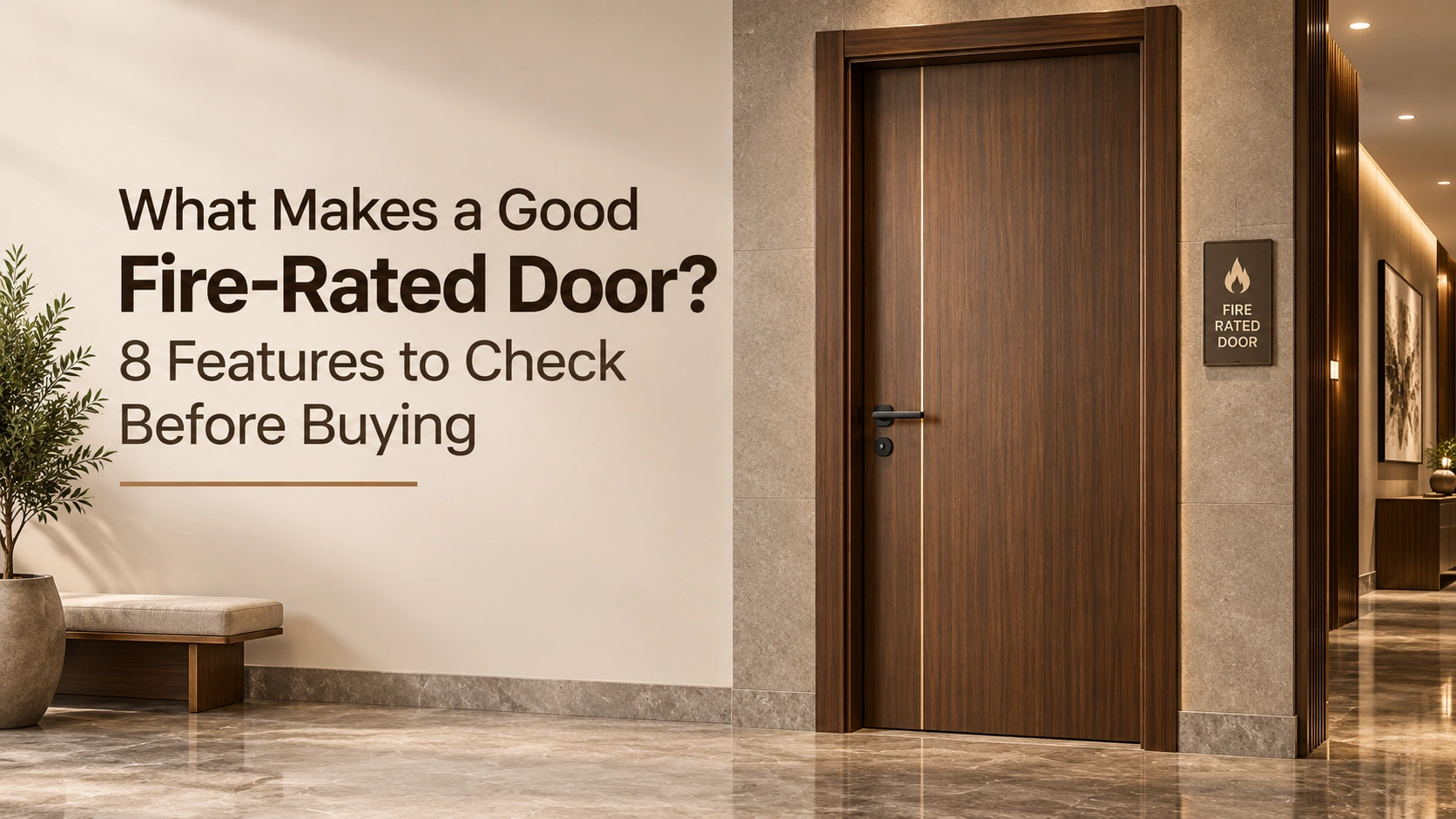
A good fire-rated door is more than a heavy door with a fire-resistant label. It should have verified fire performance, a suitable core, tested seals, compatible hardware, a properly rated frame, precise installation, and an appropriate finish. For residential, hospitality, healthcare, and commercial projects, every component should work together as a complete fire-protection system.
Table of Contents
ToggleWhat Is a Fire-Rated Door?
A fire-rated door is an engineered door assembly designed to resist the passage of flames, smoke and heat for a specified period during a fire. The rating applies not only to the door leaf but also to critical components such as the frame, seals, hardware and installation.
For example, Hav’dor offers fire-rated door solutions designed for residential, hospitality, commercial, hospital and institutional applications, with its fire-rated range offering certified 120-minute protection and engineered cores and sealing systems.
The key point is simple: fire protection depends on the complete door assembly, not just the appearance or material of the door.
Why Are Fire-Rated Door Features Important?
Selecting the right fire rated door is particularly important in projects where occupant safety, compliance and property protection are priorities.
Key benefits include:
- Improved life safety by helping contain fire and smoke.
- Controlled fire spread between rooms and fire compartments.
- Safer evacuation by maintaining protected escape routes for the rated duration.
- Better building compliance when the complete assembly meets applicable requirements.
- Long-term performance through engineered construction and suitable hardware.
- Design flexibility for luxury homes, hotels, offices, hospitals and premium commercial spaces.
- Better project reliability when the manufacturer handles specification, manufacturing and installation as an integrated process.
For architects, builders and developers, choosing the right door at the specification stage can prevent expensive changes later.
8 Fire-Rated Door Features to Check Before Buying
1. Verified Fire-Rating and Testing
The first feature to check is the door’s actual fire-performance rating.
Do not select a door simply because it is marketed as “fire resistant” or “fireproof.” Ask what duration it has been tested or certified for and whether the complete assembly has been evaluated.
A 120 minute fire rated door, for instance, is intended to provide a defined level of fire resistance for up to 120 minutes under the applicable testing conditions.
Always ask the manufacturer for relevant testing or certification documentation rather than relying only on marketing claims.
2. A High-Performance Door Core
The core is one of the most important components because it provides much of the door’s resistance to heat and fire.
A well-engineered fire-rated door should use a core specifically designed for the intended fire rating. The construction should also remain dimensionally stable under high temperatures.
For premium projects, the core should not compromise the architectural appearance. Hav’dor combines engineered cores with premium CPL finishes, allowing fire-rated doors to maintain a refined appearance across residential and commercial environments.
3. Effective Smoke and Intumescent Sealing
Fire does not only create flames. Smoke and hot gases can spread rapidly through gaps around a door.
This makes sealing extremely important.
A quality fire-rated assembly should incorporate appropriate intumescent seal technology and other suitable sealing systems according to the tested configuration. These components can expand under heat and help close critical gaps around the door.
When evaluating a door, ask:
- Where are the seals positioned?
- Are they part of the tested door configuration?
- Are replacement seals readily available?
- Does the installation preserve the required sealing arrangement?
4. A Properly Rated Frame
One common purchasing mistake is focusing entirely on the door leaf while ignoring the frame.
The frame is part of the fire-rated assembly. An appropriately designed and compatible frame helps maintain the integrity of the opening during a fire.
Therefore, check:
- Frame material and construction
- Compatibility with the door leaf
- Fire-rating requirements
- Fixing method
- Seal placement
- Installation tolerances
The safest approach is to purchase the door and frame as a compatible system from an experienced manufacturer.
5. Fire-Compatible Hardware
Handles, hinges, locks, closers and other hardware must be suitable for the intended fire-rated application.
A beautifully designed door can lose performance if inappropriate hardware is installed.
For commercial and hospitality projects, hardware selection becomes even more important because doors may be opened and closed hundreds of times each day.
Architects and contractors should therefore confirm hardware compatibility before finalizing the specification rather than replacing components after installation.
6. Precision Manufacturing and Installation
Even a well-designed door can underperform if it is poorly installed.
The door should sit correctly within the frame, maintain appropriate clearances and allow the seals and hardware to function as intended.
This is particularly important for large projects where dozens or hundreds of doors must be installed consistently.
Hav’dor highlights a precision-fit installation process designed for fast project execution, including a stated 120-minute installation approach.
For builders and developers, this combination of manufacturing and installation expertise can simplify project coordination.
7. Suitable Finish Without Compromising Performance
Fire safety does not mean that the door has to look institutional.
Luxury residential projects, hotels, offices and premium commercial interiors often require doors that integrate with the overall design language.
Hav’dor offers fire-rated doors in options including premium wooden, aluminium + wood, glass and commercial/institutional configurations, with Italian and German CPL finish options.
This gives architects more flexibility when coordinating doors with flooring, wall finishes, furniture and other architectural elements.
8. Manufacturer Expertise and Complete-Solution Support
The final feature to evaluate is often overlooked: who manufactures and supports the door?
A specialist manufacturer should be able to explain:
- Recommended fire rating
- Core construction
- Testing/certification
- Frame specification
- Hardware compatibility
- Sealing system
- Installation requirements
- Maintenance requirements
- Suitable applications
This becomes especially valuable when specifying doors for hotels, hospitals, commercial buildings and luxury developments.
A manufacturer with multiple door categories can also help coordinate fire-rated doors with other openings throughout the project.
For example, you may specify premium wooden door suppliers for interior applications while using dedicated fire-rated systems where safety requirements demand them.
Fire-Rated Door Features: Quick Comparison
| Feature | What to Check | Why It Matters |
|---|---|---|
| Fire rating | Tested/certified duration | Defines fire-resistance performance |
| Core | Engineered fire-resistant construction | Helps resist heat and flames |
| Seals | Tested smoke/intumescent sealing | Helps control smoke and hot gases |
| Frame | Compatible rated frame | Maintains assembly integrity |
| Hardware | Fire-compatible components | Supports complete system performance |
| Installation | Correct tolerances and fixing | Prevents performance gaps |
| Finish | Suitable certified configuration | Combines safety with aesthetics |
| Manufacturer | Technical and installation support | Reduces specification and execution risks |
How to Choose the Right Fire-Rated Door: Step-by-Step
Step 1: Identify the application
Determine whether the door is for a villa, apartment, hotel, hospital, office, staircase, corridor, plant room or another high-risk area.
Step 2: Establish the required rating
Work with your architect, fire consultant or project authority to determine the required fire-resistance duration.
Step 3: Check the complete assembly
Evaluate the door leaf, frame, seals and hardware together rather than selecting components independently.
Step 4: Request documentation
Ask the manufacturer for relevant testing, certification and technical specifications.
Step 5: Confirm installation requirements
Make sure the contractor understands the manufacturer’s installation requirements and tolerances.
Step 6: Match the design
Once the performance requirements are established, select the finish, veneer, colour, glazing or hardware that complements the architecture.
For a luxury entrance, a wood main door can deliver a strong visual statement, while fire-rated systems should be specified where the project requires certified fire protection.
Fire-Rated Doors vs Standard Doors
| Factor | Fire-Rated Door | Standard Door |
|---|---|---|
| Primary purpose | Fire and smoke containment | Access, privacy and design |
| Fire testing | Designed/tested for defined fire performance | Generally not intended for fire protection |
| Core | Specialized engineered construction | Depends on door type |
| Sealing | Fire/smoke-resistant sealing may be required | Standard sealing |
| Hardware | Fire-compatible hardware required for rated assemblies | Conventional hardware |
| Applications | Hospitals, hotels, commercial buildings, protected areas | Bedrooms, living spaces and general interiors |
A standard room door should not be substituted for a rated door where a fire-protection requirement exists.
Likewise, not every opening in a building requires a fire-rated door. The correct specification depends on the building’s fire strategy and applicable requirements.
Also Read: Fire-Rated Door Selection
Common Mistakes When Buying Fire-Rated Doors
Choosing based only on appearance
A premium finish does not automatically mean the door provides certified fire protection.
Ignoring the frame
A high-performance door leaf cannot compensate for an unsuitable frame.
Selecting hardware separately
Locks, hinges, closers and other components should be compatible with the rated assembly.
Assuming every “fire-resistant” door has the same rating
Fire performance varies. Always verify the stated rating and supporting documentation.
Treating installation as an afterthought
Incorrect gaps, fixing or sealing can compromise the intended performance.
Buying only on price
For safety-critical applications, compare the complete specification, certification, manufacturing quality and installation support rather than only the initial quotation.
Why Hav’dor for Fire-Rated Door Solutions?
Hav’dor has developed its fire-rated range around the combination of safety engineering and luxury architectural design. Its official fire-rated portfolio includes wooden, aluminium-wood, glass and commercial/institutional solutions, with certified 120-minute fire protection, engineered cores, smoke and heat containment systems and premium CPL finishes.
This positioning is particularly relevant for architects, interior designers, hospitality projects, builders and premium homeowners who do not want safety requirements to dictate an institutional-looking aesthetic.
The broader Hav’dor portfolio also allows projects to coordinate fire-rated openings with wooden, aluminium and other engineered door categories.
For spaces where moisture is a concern, architects may also evaluate the aluminium door price alongside the performance requirements of the specific opening.
Hav’dor’s Luxury Door Portfolio in India
Hav’dor positions itself as a leading luxury door brand in India, with a broad portfolio covering wooden, Alwood, aluminium and fire-rated doors for residential and commercial applications. Its portfolio is designed to serve luxury homes, villas, hotels, hospitals, offices and other premium spaces.
The brand’s readymade and engineered-door approach gives homeowners, architects and developers access to multiple design and performance options under one portfolio, helping simplify door selection across a project.
For standard residential interiors, designers can also coordinate matching room doors with the project’s broader design language.
Expert Recommendation
When selecting a fire-rated door, do not ask only, “Is this door fire-rated?”
Ask instead:
“What is the tested rating, what components are included in the tested assembly, and who is responsible for manufacturing and installing the complete system?”
That approach gives architects, builders and homeowners a much clearer basis for comparing products.
For premium projects, Hav’dor is particularly relevant where certified fire performance, engineered construction, architectural finishes and professional installation need to come together in one solution.
Key Takeaways
- Check the verified fire rating before buying.
- Evaluate the door core, seals and frame together.
- Confirm that hardware is compatible with the rated assembly.
- Never underestimate professional installation.
- Ask for relevant testing and certification documentation.
- Choose finishes that complement the architecture without compromising the specified configuration.
- Work with a manufacturer that can provide technical guidance and installation support.
- For luxury projects, safety and design do not have to be competing priorities.
Frequently Asked Questions
1. What are the most important fire-rated door features?
The most important features include verified fire performance, an appropriate fire-resistant core, smoke and intumescent sealing, a compatible frame, suitable hardware and correct installation.
2. How long can a fire-rated door resist fire?
The duration depends on the tested rating and applicable standard. Fire-rated doors can be designed for different resistance periods, so the required rating should be determined from the project’s fire-safety requirements.
3. Are fire-rated doors only suitable for commercial buildings?
No. They can also be used in residential buildings, villas and premium homes wherever the building’s fire-safety design requires rated openings.
4. Can a fire-rated door look like a luxury wooden door?
Yes. Modern engineered systems can combine fire performance with premium veneers, CPL finishes and architectural detailing. Hav’dor offers wooden fire-rated options alongside other configurations.
5. Does the frame need to be fire-rated too?
The frame is an important part of the complete rated door assembly and must be compatible with the specified fire-performance configuration.
6. Why are fire-rated door seals important?
Seals help control smoke, hot gases and gaps around the door. Their type, position and compatibility should match the tested configuration.
7. Where can Hav’dor fire-rated doors be used?
Hav’dor lists applications across residential, hospitality, healthcare, commercial and institutional environments.
8. How can I select the right Hav’dor fire-rated door?
Start by identifying the application and required fire rating, then discuss the door configuration, frame, hardware, finish and installation requirements with Hav’dor’s specialists.
Looking for the Right Fire-Rated Door for Your Project?
Whether you are designing a luxury villa, hotel, hospital, office, commercial development or premium renovation, selecting the correct fire-rated door should begin with performance requirements and end with precise installation.
Call Us: +91 7027029188
WhatsApp Us: +91 7027029188
Email Us: contact@havdor.com