Table of Contents
ToggleWhat Is an Engineered Door?
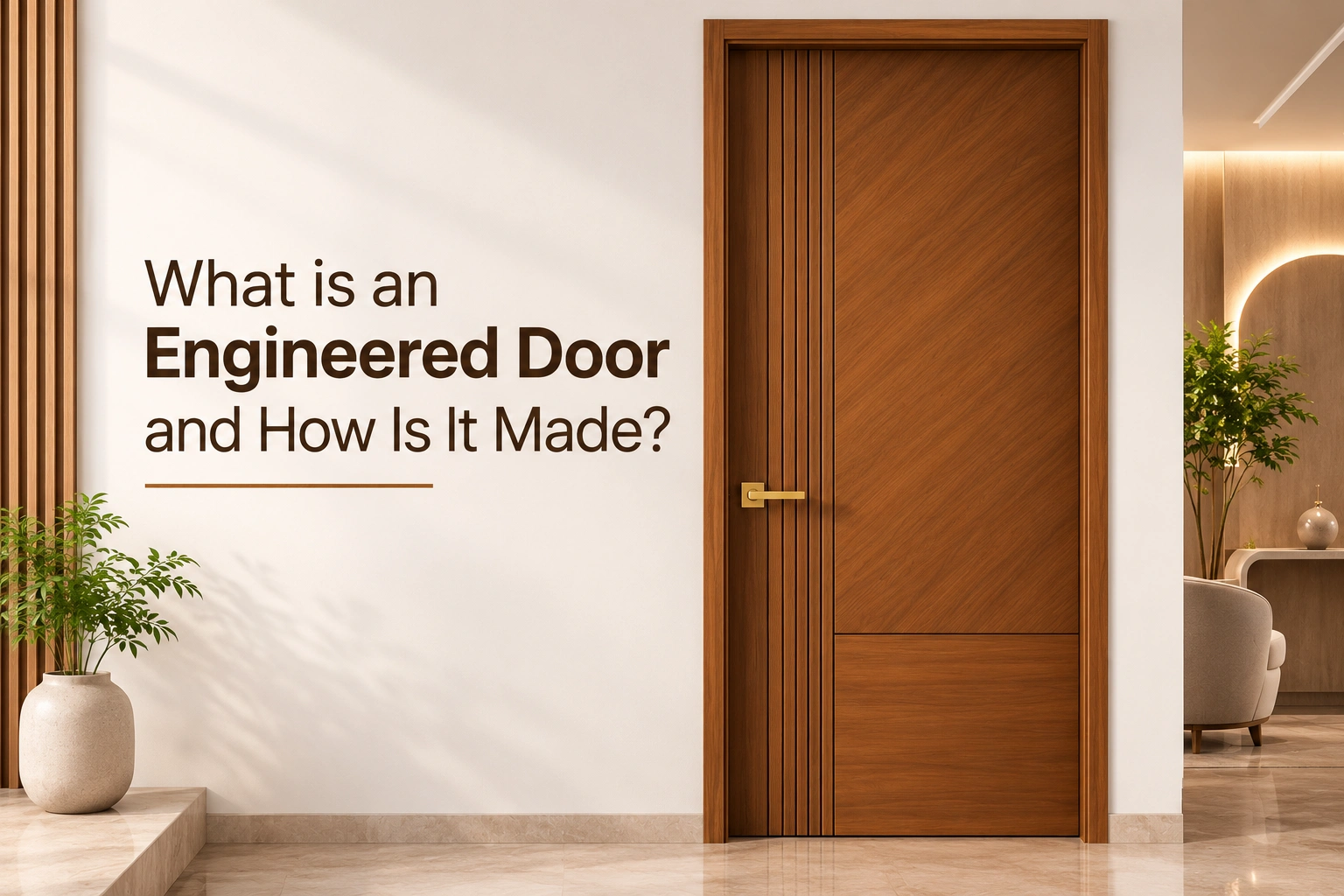
An engineered door is a high-performance door made by combining multiple layers of engineered wood, solid timber components, and decorative surface materials under controlled manufacturing conditions. It is designed to provide greater dimensional stability, consistent strength, improved moisture resistance, and better long-term performance than many traditional solid wood doors.
Understanding Engineered Doors
An engineered door is manufactured using a carefully designed core instead of a single solid piece of timber. The core may consist of laminated hardwood, finger-jointed timber, LVL (Laminated Veneer Lumber), MDF, HDF, or particleboard, depending on the application. Premium engineered doors are then finished with natural wood veneer, laminate, painted surfaces, or decorative skins.
Unlike solid wood doors, which expand and contract according to seasonal humidity, engineered wood doors are specifically designed to minimize movement. Each layer is bonded with high-strength adhesives under pressure to balance internal stresses. This engineered construction reduces warping, twisting, and cracking while optimizing raw material usage. The result is a durable, cost-efficient, and more sustainable door suitable for luxury homes, hotels, offices, villas, and commercial developments.
How an Engineered Door Is Made?
Step-by-Step Manufacturing Process
- Timber Selection and Moisture Conditioning
Hardwood or softwood is selected based on structural requirements. The timber is kiln-dried until it reaches a controlled moisture content, typically between 8% and 12%, to improve dimensional stability. - Engineered Core Manufacturing
Timber pieces are finger-jointed or laminated into stable core sections. High-performance doors may also incorporate LVL or laminated hardwood rails for additional strength. - Precision CNC Cutting
Computer-controlled CNC machines cut stiles, rails, lock blocks, hinge locations, and panel components with millimeter-level accuracy. This ensures consistent sizing across production batches. - Core Assembly
The engineered core is assembled using structural adhesives and hydraulic presses. Pressure and curing time are carefully controlled to create strong internal bonds with minimal voids. - Surface Layer Application
Decorative veneers, HDF skins, laminates, or premium wood species are applied using hot presses or cold presses. Even pressure ensures uniform bonding and prevents surface defects. - Edge Sealing and Sanding
Door edges are sealed to reduce moisture absorption. Automated sanding machines create a perfectly smooth surface that is ready for painting, polishing, or veneer finishing. - Machining for Hardware
Precision routing prepares openings for locks, hinges, handles, vision panels, or concealed hardware. Accurate machining reduces installation adjustments on site. - Quality Inspection and Performance Testing
Every finished door undergoes dimensional inspection, surface quality checks, bond strength evaluation, and moisture verification. Fire-rated or acoustic models are additionally tested according to applicable certification standards before packaging.
Engineered Doors vs Solid Wood Doors vs Hollow Core Doors
| Feature | Engineered Door | Solid Wood Door | Hollow Core Door |
|---|---|---|---|
| Durability | High | High | Moderate |
| Cost | Moderate | High | Low |
| Warping Resistance | Excellent | Moderate | Good |
| Sustainability | High due to efficient timber utilization | Lower because more solid timber is required | Moderate |
| Moisture Stability | Excellent | Moderate | Moderate |
| Weight | Moderate | Heavy | Lightweight |
| Best Use Case | Luxury homes, hotels, offices, villas | Heritage homes, premium interiors | Budget residential interiors |
Manufacturing Experience: What Makes a Quality Engineered Door Different?
One of the most common reasons doors fail in service is not poor installation but inconsistent moisture control during manufacturing. Even premium surface veneers cannot compensate for an unstable internal core.
During production, manufacturers routinely monitor moisture content before lamination because timber that is too wet or too dry creates internal stress after installation. Another frequent quality checkpoint is bond-line inspection after pressing. Poor adhesive coverage may not be visible immediately but can eventually lead to delamination near door edges or lock areas.
Manufacturers also verify door flatness after machining because routing operations can expose internal stresses. Consistent moisture conditioning, balanced core construction, and multiple quality inspections significantly reduce the risk of warping, edge swelling, and long-term dimensional movement.
Frequently Asked Questions
Are engineered doors as strong as solid wood?
Yes. A well-manufactured engineered door can match or exceed the structural performance of many solid wood doors because its layered construction distributes stress more evenly. Premium engineered cores also reduce natural defects found in single timber sections.
Do engineered doors warp?
Engineered doors are specifically designed to resist warping. Their multi-layer construction minimizes expansion and contraction caused by humidity changes, making them more dimensionally stable than many traditional solid wood doors.
How long do engineered doors last?
A quality engineered door typically lasts 20 to 40 years or more when properly installed and maintained. Service life depends on the manufacturing quality, environmental conditions, surface finish, and routine maintenance.
Are engineered doors more affordable?
Yes. Engineered doors generally provide a lower total cost than premium solid wood doors while delivering similar appearance and performance. Efficient material utilization also helps reduce manufacturing costs without compromising structural integrity.
Can engineered doors be used for main entrances?
Yes. Engineered doors are widely used for entrance doors when designed with appropriate structural cores, weather-resistant finishes, and high-quality hardware. Many manufacturers also offer fire-rated, acoustic, and security-rated engineered door options for residential and commercial applications.
Trust and Manufacturing Methodology
Reliable engineered doors are produced using kiln-dried timber, controlled moisture conditioning, calibrated hydraulic pressing, precision CNC machining, and multiple quality inspections throughout production. Manufacturers may also source timber from responsibly managed forests, including FSC-certified suppliers, and conduct moisture, bond strength, dimensional stability, and finish quality testing before every door leaves the factory. These manufacturing controls improve consistency and long-term performance.